The Lilium guide

The Coppedè district a guide to Liberty-style Rome

Fontana delle Rane, Villini delle Fate, Palazzo del Ragno — a short walk from the hotel

Less than a twenty-minute walk from the Lilium, heading up Via Nomentana, there is a corner of Rome that few tourists know and that feels almost dreamlike: the Coppedè district. For us it is not simply an excursion out of the way — it is the very architectural language the hotel speaks, the same Liberty of flowers, wrought iron and imagination.

Rome by night, the northern quadrant that is home to the Liberty-style Rome of the Coppedè district

A district not found in the guidebooks

Who was Gino Coppedè

The district takes its name from its creator: Gino Coppedè, a Florentine architect born in 1866, trained in his father's wood-carving workshop and then at the Academy of Fine Arts. Between 1915 and 1927 he built, on commission from the financiers Cerruti and Becchi of the Società Anonima Edilizia Moderna, a residential complex conceived for the refinement of upper-middle-class Rome in those years. Coppedè died in Rome in September 1927, and the work was completed by his son-in-law Paolo Emilio André.

Do not expect a district in the usual sense: it is a compact block of buildings between Via Salaria and Via Nomentana, in the Trieste quarter. Dozens of palazzi and villas, built in an unmistakable "Coppedè style" — a personal fusion of Liberty, Art Déco, Gothic, medieval, Greek and Roman references. An eclecticism that elsewhere would be chaos, and that here finds a surprising balance.

It is the Italian version of European Art Nouveau, taken to the extreme of imagination. The same aesthetic family — the flower, the curve, the handcrafted detail — from which the Lilium's identity is born.

The threshold of the dream

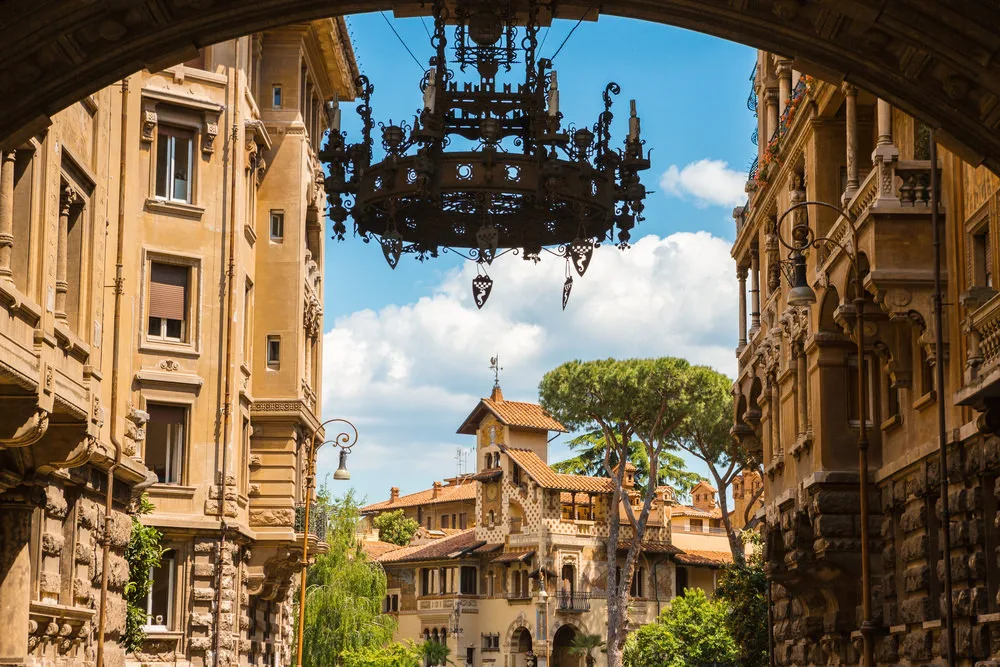
The archway and the lantern

You enter from Via Tagliamento, where a great archway connects two buildings — the Palazzo degli Ambasciatori — and marks the dramatic entrance to the district. At the centre of the archway hangs an imposing wrought-iron lantern, which has become the symbol of Coppedè. The vault is decorated with a winged Victory and mosaics of eagles: a curtain rising on another world.

Beyond the archway opens Piazza Mincio, the heart of the district. This is where you stop to look up: balconies, bow windows, little turrets, friezes, wrought iron woven into floral motifs. Every façade tells a different story, and no two are alike. It is worth arriving early in the morning or in the late afternoon, when the raking light brings out the details and the square is almost yours alone.

The highlights not to miss

Piazza Mincio and its masterpieces

Centre of Piazza Mincio

Fontana delle Rane

At the centre of the square, the Fontana delle Rane (Fountain of the Frogs) was built in 1924, probably inspired by the sixteenth-century Fontana delle Tartarughe (by Giacomo della Porta and Taddeo Landini) in the Jewish ghetto. The bronze frogs from which the water spouts give it its name. Legend has it that the Beatles dived in fully clothed after a Rome concert in the Sixties — a delightful tale, though not reliably documented.

Overlooking the square

Villini delle Fate

The Villini delle Fate (Fairy Villas) complex is the fairy-tale heart of the district: frescoes, stained glass, marble, terracotta and brick combine in a tribute to the Italy of the medieval communes, with echoes of Florence, Venice and Rome. Every surface is decorated — figures, coats of arms, Latin mottoes. It is the purest example of Coppedè's imagination.

On Piazza Mincio

Palazzo del Ragno

The Palazzina del Ragno (Spider Building) owes its name to the large spider carved on its façade, a symbol of industriousness and work, accompanied by a Latin motto. The building mixes Assyro-Babylonian and Liberty influences, with a solemn entrance and details that reward those who look up. One of the most photographed subjects in the district.

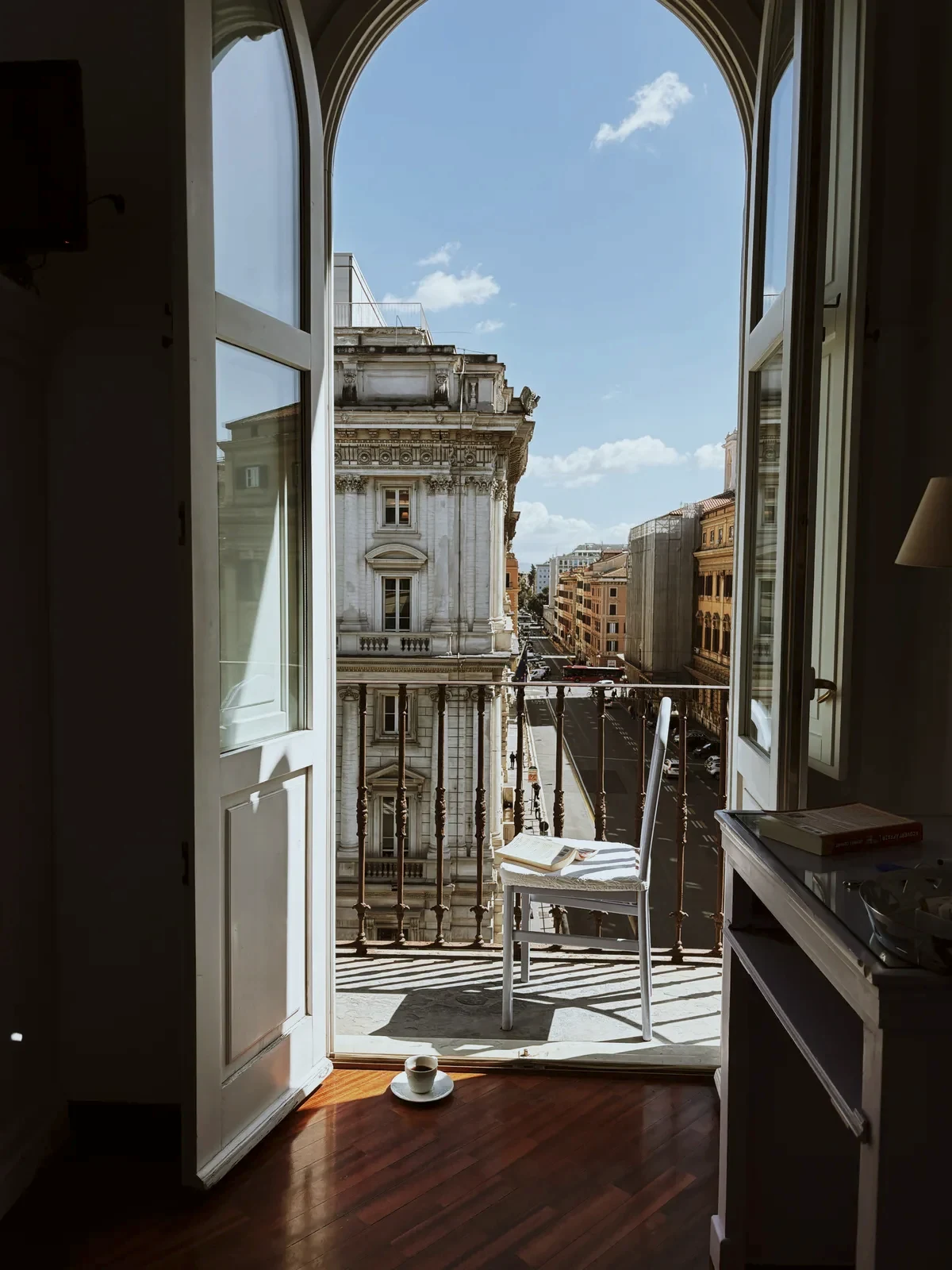
The Wisteria Room at Lilium Boutique Hotel — the hotel's Liberty aesthetic, with a view over Rome

The style, told from within

The Liberty of the Lilium

What you admire on the façades of Coppedè — the flower, the curve, the wrought iron, ornament that becomes storytelling — is the same language the Lilium keeps within its own walls. We are not a hotel that quotes Liberty for the sake of looks: we live in it. Each of our fourteen rooms bears the name of a flower, and Art Nouveau is the grammar in which they are conceived.

The Wisteria Room (Camera dei Glicini), for example, translates into its furnishings the very floral motif you find at Coppedè etched into the wrought iron of the balconies and the friezes of the façades. To sleep at the Lilium after a stroll through Piazza Mincio is like continuing the same sentence: the same taste, the same era, the same care for detail.

That is why Coppedè is not, for us, simply an attraction worth flagging. It is the loveliest way to explain who we are. You can discover all the Lilium's rooms and choose yours before you arrive.

How to get there from the Lilium

From the hotel to Piazza Mincio

approx. 20 min·Flat

On foot, along Via Nomentana

From the hotel on Via Venti Settembre you reach Porta Pia and take Via Nomentana, the elegant tree-lined avenue of the northern quadrant. Heading up it — skirting Villa Torlonia — in just over a quarter of an hour you are on Via Tagliamento, in front of the archway with its lantern. A walk almost entirely on the flat, in the shade of the plane trees.

approx. 8 min·Bus or taxi

In a few minutes on four wheels

If you prefer, from the stops on Via Nomentana several bus lines head up towards the Trieste quarter in a few minutes. A taxi from the hotel takes about eight minutes in normal traffic. The reception is always on hand to point you to the right stop or call you a car.

Frequently asked questions

Questions about the Coppedè district

Where is the Coppedè district in Rome?

The Coppedè district lies in the Trieste quarter, in the northern quadrant of Rome, between Via Salaria and Via Nomentana. Its heart is Piazza Mincio, and its dramatic entrance is the archway on Via Tagliamento. From Lilium Boutique Hotel, on Via Venti Settembre near Porta Pia, it is about a twenty-minute walk heading up Via Nomentana.

Who designed the Coppedè district?

The district takes its name from the Florentine architect Gino Coppedè (1866–1927), who designed and built it between 1915 and 1927 on commission from the financiers Cerruti and Becchi of the Società Anonima Edilizia Moderna. On his death, in Rome in September 1927, the work was completed by his son-in-law Paolo Emilio André.

What is there to see in the Coppedè district?

The main highlights are the entrance archway on Via Tagliamento with its wrought-iron lantern, the Fontana delle Rane at the centre of Piazza Mincio (built in 1924), the Villini delle Fate with their fairy-tale frescoes, and the Palazzo del Ragno, recognisable by the large spider carved on its façade. In all, the district numbers dozens of buildings and villas, all admirable from the outside.

How much does it cost to visit the Coppedè district?

The visit is completely free: the district is an open urban area, freely walkable on foot at any hour. The buildings are private and are admired from the outside; no tickets or reservations are needed. All you need is comfortable shoes and the urge to look up.

Why is the Coppedè district called Liberty style?

The "Coppedè style" is a personal variant of Italian Liberty, the home-grown version of European Art Nouveau. Coppedè blends floral decoration with medieval, Gothic, Baroque and classical references into a unique eclecticism. It is the same aesthetic family that inspires the interiors of Lilium Boutique Hotel, where every room bears the name of a flower.

The same Liberty, from within

Sleep in Liberty-style Rome

Stay at Lilium Boutique Hotel and experience from within the style you admire at Coppedè — fourteen rooms, one flower each, a short walk from Piazza Mincio.

Direct booking Save up to 10%